
3 posts tagged with "vulnerabilities"

vulnerabilities tag description

View All Tags

VulnerableCode API Deprecation and V3 Introduction

· 2 min read
Tushar Goel
Software Engineer

The AboutCode team is planning to deprecate the V1 and V2 API of VulnerableCode (public.vulnerablecode.io) by the end of Q2 2026 (June 20, 2026). We are introducing V3 API and UI by the end of January 2026.


Why this new API

The existing V1 and V2 APIs are both based on the “vulnerabilities” model, designed to aggregate information from multiple advisory sources based on identifiers and aliases. With the "vulnerabilities" model it is difficult to determine which source is correct because of the combination of sources. This may result in data from one source overwriting data from another source.

What to expect from the new V3 API and UI

Moving forward, VulnerableCode will report “advisories” for packages and not “vulnerabilities”.

Currently if a package has 4 advisories and those 4 advisories were correlated with each other by their aliases and identifiers, we report a single vulnerability affecting that package. The new approach in V3 will report 4 individual advisories.

The new “advisories” model introduces an Advisory ID (AVID) for each advisory in VulnerableCode. An AVID will have different components like the source and the natural unique identifier used at that source. For example if we are importing an advisory from “nodejs_security_wg” and it’s identified by its ID “123”, the AVID will be “nodejs_security_wg/123”.


Plan and Timeline

We are planning to complete the following tasks by the end of January 2026:

  • Redesigning the API and UI
  • Migrating our existing data sources
  • Documenting the V3 API and the new UI

Current Status

https://public2.vulnerablecode.io/v2 uses the new advisory based UI https://public2.vulnerablecode.io/api/v3/ uses new API, but it is still under development and not ready for production use.


Migration Progress

You can track the progress of migration here:
https://github.com/orgs/aboutcode-org/projects/52/views/48

PURLs of Wisdom

· 12 min read
Philippe Ombredanne
AboutCode Lead Maintainer

Accurately identify third-party software packages with PURL.

purl-image

If you need to generate (or consume) Software Bill of Materials (SBOMs), then you need a standardized way to communicate information about what components are in your software.

If you’re using or building applications, you need tools to determine if there are any known security issues with open source and third-party components.

If you’re building tools for Software Composition Analysis (SCA) like analyzing the origin, license, security, and quality of the code across different ecosystems. You need a simple way to identify the packages used.

Package URL (PURL) is a new open source standard to convey accurate identifications of the third-party software packages that were used.

standards_2x https://xkcd.com/927/

A universal identifier like PURL provides both internal developers and external users with direct access to key information about those packages like vulnerabilities and licenses. PURL reduces friction by providing continuity across tools, processes, development environments, and ecosystems.

It’s not complex. The idea behind PURL was to find a simple way to identify a software package based on its name. Just by looking at the code, you can determine the Package URLs of the open source packages that you are using. PURLs are defined by the intrinsic nature of the software you observe, and that makes the difference.

A car is a good analogy for demonstrating the superpower of easily identifying something just by looking at it. You can determine the make and model of a car by observing it. You can then uniquely identify by looking at the license plate.

In contrast, identifiers previously used for software packages are complicated. In the world of security, the National Vulnerability Database (NVD) uses an identifier for software packages called Common Platform Enumeration (CPE).

Extending the car analogy, identifying the CPE is like trying to find the internal model number from the manufacturer: you need to have access to extra information that are not obvious and not readily available by watching the car. Using CPEs to query the NVD requires prior knowledge of this extra information and arbitrary assigned identifiers, adding complexity with an additional step.

Package URLs, in comparison, are simple and easy for developers to know what the package actually is! By looking at the car, we can easily observe the make, model, color, condition, and the license plate number, which we can use to universally identify the car more efficiently. Finding the internal manufacturer part number with a central authority to identify it is too cumbersome. PURL brings us simplicity.

PURL can be extremely helpful for organizations mitigating high-profile security issues related to open source package vulnerabilities. More information is usually required to fix these vulnerabilities than what you can discover by looking at the code. The conjunction of several high-profile security issues heightened the need to figure out what third-party software packages are included in many software products.

For example, there was that major security bug with Log4j, which was really in Log4j version 1.2.17. How can you know if you use Log4j v1.2.17 when there’s a security issue? It’s powerful to know just by looking at the code. But if you need to know that it’s called apache:log4j, then it’s much harder and this is required to query NVD.

purl-image

PURL removes the friction to search complex auto-generated values in databases. This makes PURL even more useful for the larger software development community.

How PURL was made

The origins of PURL can be traced very specifically to 2017 when we needed a new way to identify packages in ScanCode Toolkit.

As part of ScanCode v3, we designed parsers for package manifests, like a Maven POM, a Python setup.py, and a npm package.json. But, it was incredibly difficult to quickly identify these packages across ecosystems. We considered different schemas for different environments, but quickly understood that would be way too complicated. After looking at existing options in different open source communities, we discovered a Google project called Grafeas.

Grafeas defined something promising and wonderfully simple called resource URLs, derived from and contributed by JFrog and their product JFROG XRAY. In a resource URL, a node package would be identified as npm://name@version. This is quite similar to URL nomenclature, but modifying the prefix to identify the development environment and then, essentially a name:version. Grafeas was already in use in various places, so we created an issue describing a few details to work out and pinged R2wenD2, who was actively working on the project.

I also reached out to the OSS Review Toolkit (ORT) project to discuss best practices for identifying packages across ecosystems related to AboutCode data specs. At that time, we used a system with a name, namespace, and version for some packages, based on the resource URLs in Grafeas. But, we still needed a common syntax to easily identify these packages in and across different ecosystems.

Open source projects like Grafeas, Libraries.io, Fabric8 from RedHat, and several others were all doing similar things, but none solved this issue. I cherry-picked the best components of each, and built the first version of Package URL in late October 2017.

As part of nexB’s core principle of FOSS for FOSS, we moved PURL to a new, separate organization on GitHub to better collect effective feedback and share ownership. We invited every key contributor as a co-maintainer/co-owner, including R2wenD2 from Google, Sebastian Schubert from ORT, and later on Steve Springett from CycloneDX, who was one of PURL’s early adopters and for which, the spec was key.

Relinquishing exclusive control early on but maintaining a strong design direction with the key contributors was critical for the ongoing development and success of the PURL project.

With the AboutCode projects, PURL is the critical connector. Whether it’s detecting a package in ScanCode Toolkit, looking for vulnerabilities in VulnerableCode, or reporting complex scans of container images in ScanCode.io, the output is PURLs. The input is PURLs whenever we consume a CycloneDX or SPDX SBOM. We can easily consume and exchange information extracted by PURLs from other tools. That has proved critical to the success of these open source projects.

Casting PURL in the real world

The basic identification of packages is simple and easy. But, there are many levels of depth beyond the package name and version, including the metadata details, like the software license, that APIs can look up. This gets tricky when the metadata details are not documented effectively or the documentation is poor or messy. All this adds more complexity!

Part of the overall identification process is knowing what files were provisioned or provided by the software package – this is very important in verifying the integrity of a package. Once the package is identified and installed on the machine, then you need to ensure that it really is what it’s supposed to be.

There are all these layers, which matter when you don’t have any package manifest or structured information about the package. It’s more complex because you need to accumulate different clues to find the potential origin, like copyright and permissions, URLs, processing READMEs of semi-structured information, and eventually matching.

Matching is performing a lookup across a larger database of known packages. In modern software development, the vast majority of packages will come with a PURL and don’t need any kind of matching. Matching is the signatory technique to help when there is murkier or more difficult information.

In some cases, matching is used for Microsoft .NET and NuGet packages. Each NuGet package is a set of files, typically DLLs and executables and they may be installed and bundled together. Once this has happened, you don’t know anymore which DLLs came from which NuGet, with NuGet now being the package. It’s not easy to find just by observing the deployed binaries. It requires some matching back to each of the packages to figure out, like “Oh! This DLL came from this Microsoft NuGet, and this other DLL came from this Acrobat NuGet.” Some high level matching of whole files can be very useful to complete the identification, typically NuGet, Apache Maven, or Java environments.

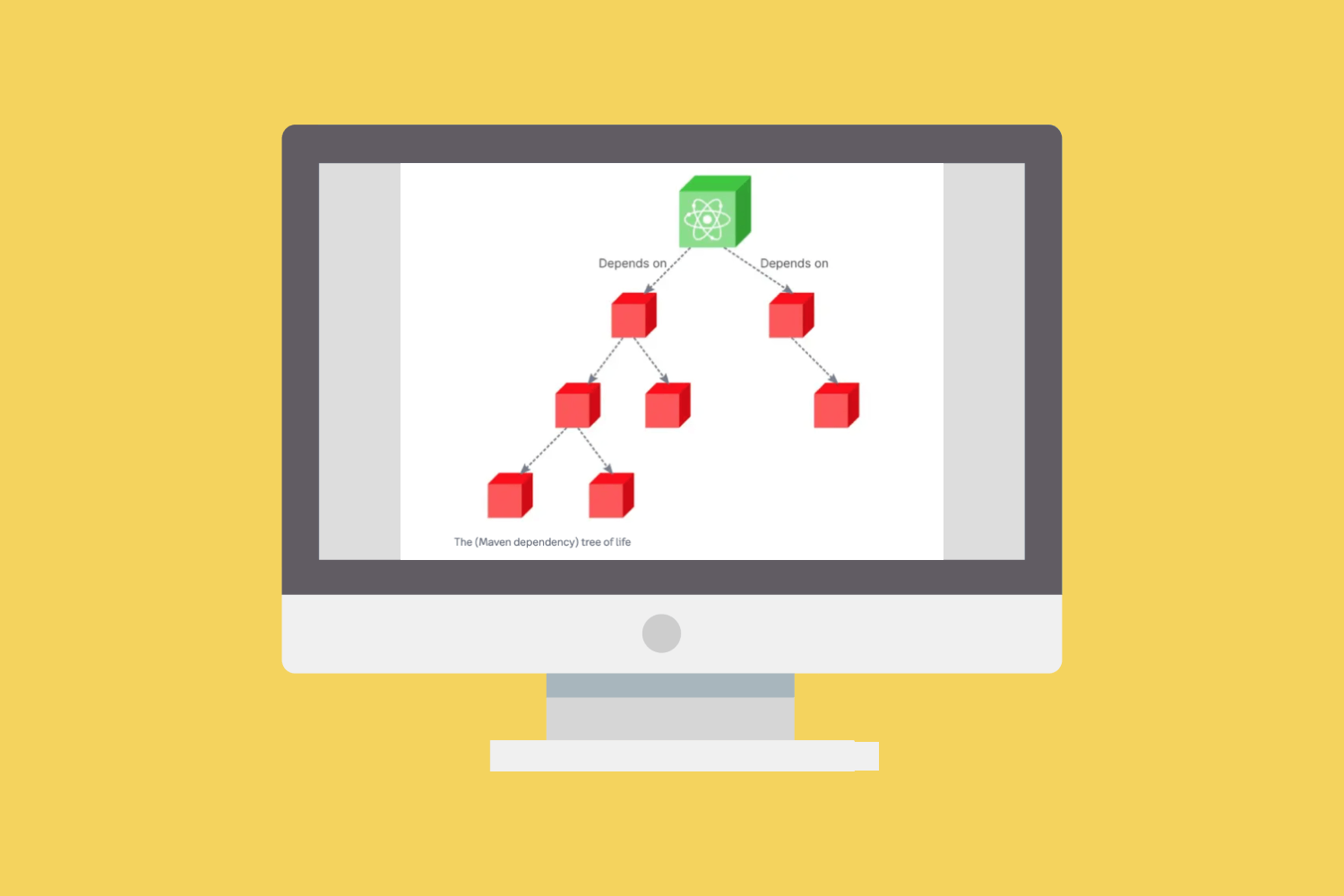
Dependency resolution is being able to literally unwind the twine ball. First, you state the direct dependencies – you need this and that and this package, and this version or a version range. Next, you go for the second level of dependencies, and then, the third level, until you go all the way down.

There is a complex set of software code called “solvers” or “dependency resolvers”, that ensure the set of versions are compatible together. The input for these solvers is a set of package versions (and in some cases, package version ranges) to find all the dependencies in the complex dependency trees. Each package manager uses their own conventions and approaches to list the various constraints so there is no easy way for a unified approach to dependency resolution.

The AboutCode team is currently working on VERS, as a universal standard for version ranges identifiers to enable universal dependency resolution across all package managers and to express constraints across system packages and application packages.

Dependency resolution is designed to determine which version for a given application, and then fetch this installed version. Typically, package managers – like npm, pip for Python, a bundler for Ruby or Python – perform the dependency resolution, and once they find the release of a package to install, they download, extract and install them.

Looking at software that’s already been built, there’s nothing to understand about dependency resolution that previously happened. There’s a set of packages downloaded and installed by the package management tool in real-time, so dependency resolution matters most during the development when building the software. Upstream, this can be an extremely complex and difficult process of reverse engineering the dependency resolution.

A new approach called Non-vulnerable dependency resolution merges and combines the dependency constraints, which are functional dependencies, to avoid using packages.

The amount of code that can be identified by PURL depends on the environment. For more general purpose software like web, backend, desktop, and mobile development, usually 95 to 99% of the code used comes from package repositories – unless you use proprietary code, of course. But for the code that has third-party open source origins, everything is easily identified by PURL.

The main difference in PURL’s efficacy is in embedded vs non-embedded software development.

Embedded systems or environments using native code like C or C++ are more complex for PURL because these embedded systems don’t typically utilize a package manager. There are some new package managers for embedded systems like Yocto and buildroot for Linux and Conan for C++.

Tools for embedded systems like Yocto for Linux or buildroot may not use PURL, but still have a strong traceable origin of the code. In other cases, the “generic” type with a download URL can be used as a qualifier. So even if they may not use PURL, there is a good enough approach that can handle these exceptions.

In general, there’s no such thing as package managers, and PURL can still be used, but it’s going to be a bit more complex to do proper identification there – which is the big difference between embedded vs. non-embedded kind of software development. With caveats also because you have tools for embedded development now such as Yocto or buildroot that may not use PURL but still have a very strongly traceable origin of where the code comes from. In other cases we can use the “generic” type with a download URL as a qualifier. So even if they may not use PURL, there is a good enough way that you may not use them all the time but helps deal with these exceptions!

PURL of a FOSS price

PURL makes identification easy, across tools and ecosystems. The ability to compose with other tools – and those tools being free and all available with PURL as a mostly universal identifier – means users don’t have to struggle with integrations and can choose the best-in-class tool they want to use.

PURL was originally built for Python because that’s the language of preference for ScanCode Toolkit. But the specification and libraries for PURL libraries are simple enough that there are now implementations in C#, .NET, JavaScript, Go, Java, Ruby, Swift, Python, PHP, Rust and more. We even have more than one PURL implementation in Java for instance. A list of the available implementations is available at https://github.com/package-url/.

PURL was specifically designed to not be unique to any organization’s projects. As a new open source standard, PURL helps the ecosystem of SCA tools and provides more flexibility and more options for end users to replace, exchange, and combine tools together using PURL.

As Jackie Kennedy meant to say, “PURLs are always appropriate.”

Non-Vulnerable Dependency Resolution

· 4 min read
Tushar Goel
Software Engineer

Dependencies may come with vulnerabilities that can be exploited by attackers.

non-vulnerable-dependency

Dependency resolution is the process of identifying and installing the required software packages to ensure that the software being developed runs smoothly. However, these dependencies may come with vulnerabilities that can be exploited by attackers.

Until now, these contexts have been considered as separate domains:

  • Package management tools resolve the version expression of the dependent package of a package to resolved versions in order to install the selected versions.

  • Security tools check if resolved package versions are affected by known vulnerabilities (even when integrated in a package management tool)

As a result, the typical approach to get a non-vulnerable dependency tree is:

  1. Resolve a dependency tree and install the resolved package versions.

  2. For each resolved dependent package version, translate the identifiers and look in a vulnerability or bug database to determine if a version is affected by a vulnerability and which package version fixes this vulnerability, if any.

  3. Update the vulnerable versions with fixing versions.

  4. Repeat step 1 until you have exhausted all possibilities. Stop on conflicts if a resolution is not possible when considering functional requirements and vulnerability fixing versions.

That approach is complex, tedious and time-consuming. It also suggests non-vulnerable versions without consideration for the functional dependency requirements necessary when reconsidering each dependency separately. This is a waste of time and effort as the non-vulnerable suggestion may not satisfy the functional constraints. Stated otherwise, the result may be a non-vulnerable package tree where packages do not work together and do not satisfy functional requirements, e.g., this results in potentially non-functional software.

maven-find-transitive-dependencies

Here at nexB, we propose a new method and process to resolve software package vulnerable version ranges and dependency version constraints at the same time. This enables developers to obtain a resolved software package version tree matching the blended constraints of functional and vulnerability requirements in order to provide non-vulnerable and up-to-date software code.

The process would go through these typical steps:

  1. Given an input software package, collect its direct functional dependency requirements from its manifests and/or lockfiles. Optionally, parse these requirements to normalize them as Package-URLs and Version Range Specs.

  2. Fetch the known package versions set from the ecosystem package registry.

  3. Collect known affected package versions ranges and fixed ranges from a vulnerability database or service using the identifiers from step 1.

  4. Combine the version ranges of each dependency from steps 1 and 3 in a single new version range and for each dependent package.

  5. Feed the combined ranges from step 4 as input to the dependency resolver. Obtain resolved dependencies that satisfies both constraints. The resolver may further request additional versions and ranges using the processes from steps 1 through 4 when new dependent packages are collected during the resolution process.

  6. Obtain and output the results of the combined resolution of step 5. Report conflicts and optionally suggest conflict resolutions.

With this new process, we get a resolved package dependency tree with versions that satisfy both functional and vulnerability or bug constraints in a single resolution pass.

It’s worth noting that non-vulnerable dependency resolution is an ongoing process. Developers should regularly monitor their software packages for any newly discovered vulnerabilities and update their packages accordingly. This is particularly important when new vulnerabilities are discovered in commonly used packages, as these can have a significant impact on a wide range of software applications.

In conclusion, non-vulnerable dependency resolution is an essential practice that should be adopted by all developers. By selecting software packages that are free from known vulnerabilities, developers can significantly reduce the risk of security breaches in their software applications. Additionally, regularly monitoring and updating packages, as well as ensuring that packages are obtained from trusted sources, can further enhance the security of software development.

To understand this topic in more detail, read this defensive publication on Non-Vulnerable Dependency Resolution from the Technical Disclosure Commons.